
The complete guide
How To Choose A Kids Single Quilt Cover Set That Actually Lasts
The problem with kids' bedding
Most kids' bedding fails for one of two reasons. Either it looks great in the photo and feels like paper once it is on the bed, or it is lovely to sleep under and falls apart after ten washes. A child's bed gets more laundry traffic than any other bed in the house. Drinks spill. Noses run. Someone decides to eat a biscuit under the covers. If the set cannot handle a weekly cold wash without pilling, fading or losing its shape, it ends up in the back of the linen cupboard and you are shopping again in six months.
The other issue is that kids' rooms are hard to decorate on a budget. Furniture is expensive and paint is a weekend job. The bed, though, takes up a big chunk of the visual space, often a third of the floor and most of the eye line as you walk in. Change what is on the bed and you change the feel of the room in about four minutes. That is why a good quilt cover set does more decorating work per dollar than almost anything else you can buy.
What a two-piece set actually gives you
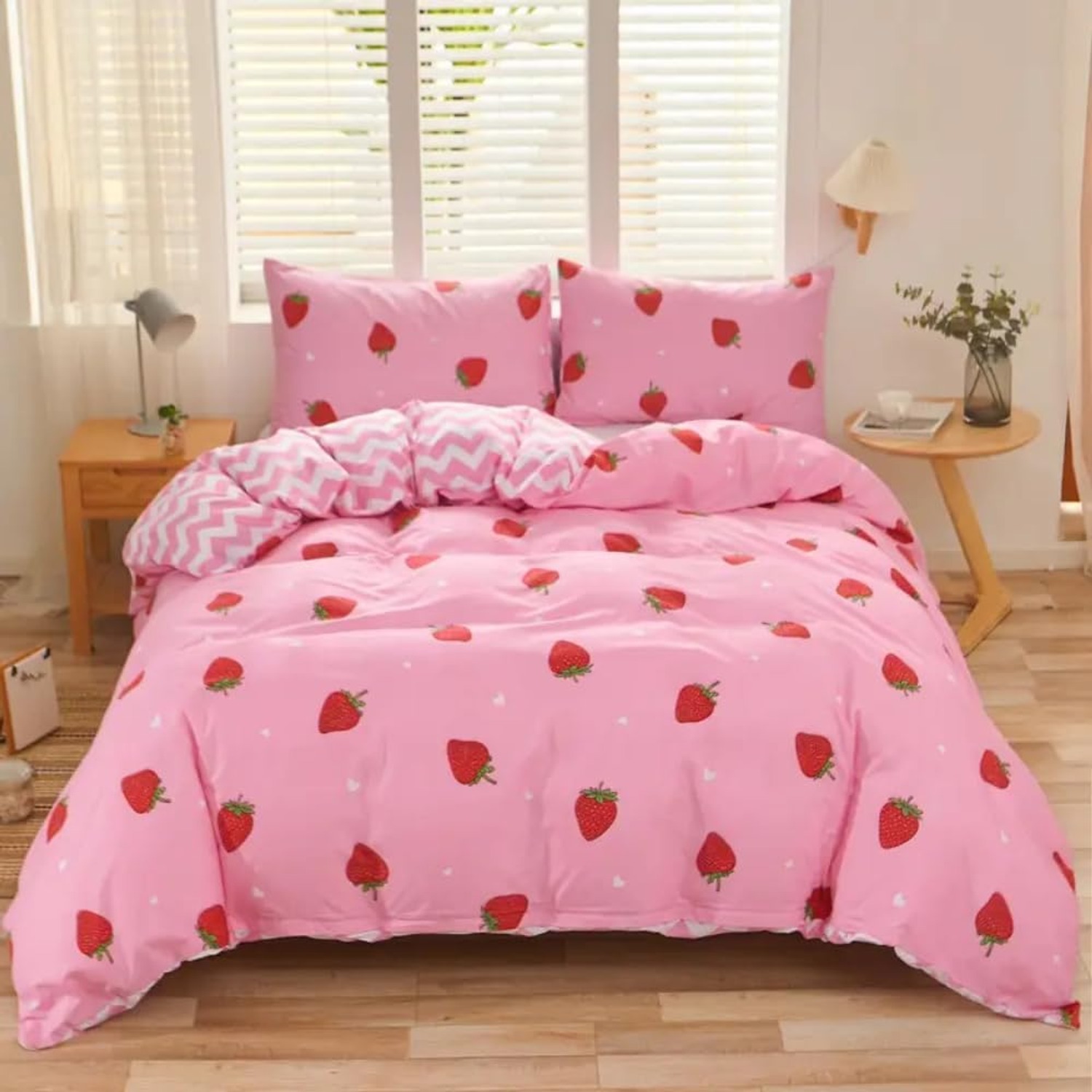
This set is two pieces, a 140 x 210 cm quilt cover and one pillowcase at 48 cm by 73 cm. That pillowcase measurement is worth noting because it is the standard Australian pillow size. You are not going to need to go looking for an odd pillow to make it fit.
What is not included is a fitted sheet. Some people find that annoying and some people prefer it. The argument for a two-piece set is that fitted sheets wear out faster than quilt covers, since they take the direct contact. Buying them separately means you can keep three or four plain fitted sheets in rotation and swap the quilt cover whenever you want a change. A plain white or soft pink sheet under a strawberry bedding set looks deliberate rather than mismatched.
Why microfibre, and what it feels like
Microfibre is a woven fabric made from very fine synthetic fibres. The fibres are thinner than a strand of silk, which is what gives microfibre its smooth hand feel. This set is 100% microfibre at a 300 thread count.
A few things follow from that. It feels smooth rather than crisp. Cotton percale has a cool, papery snap to it that some people love. Microfibre is softer and a bit more fluid. Kids generally prefer the softer feel, especially younger ones who are sensitive to texture.
It is light. The fabric does not add much weight on top of the quilt itself, so your child is not fighting the covers. If you have a kicker who ends up half out of bed by midnight, lighter bedding helps.
It dries fast. During a wet Melbourne week or a humid Brisbane summer, that is not a small thing. You can wash it in the morning and have it back on the bed that evening without using the dryer at all.
It resists creasing. You can pull it out of the machine, shake it, and put it straight on the bed. No ironing required unless you really want a sharp finish.
Closures matter more than you would think
The quilt cover on this set closes with buttons along the opening. Buttons are the quiet workhorse of bedding. They hold the quilt in position so it does not migrate to one corner during the night, and they are easy for a child to work with when they start helping make their own bed. A six or seven year old can manage buttons. Zips jam and poppers pop open.
The pillowcase is an envelope style, meaning there is an internal flap that folds over the end of the pillow. Nothing hard, nothing fiddly, and the pillow stays put. For a kids' bed this is the sensible choice, because there is no zip pull to press against a cheek at two in the morning.
Who this set suits
This is a single size set, so it suits the standard single beds that most Australian kids sleep in. That includes a lot of bunk beds and trundles, which usually take a single mattress. If you are shopping for the best kids single quilt cover for a bunk, lightweight bedding is a real advantage, because making a top bunk is awkward and heavy covers make it worse.
Age wise, a strawberry print tends to work from preschool up through primary school. Fruit prints have a longer shelf life than licensed characters, which a child can go off within a term. If you are buying for someone else's child, that matters. You are far less likely to pick wrong with a fruit print than with a specific show or film.
It also works as a gift. Bedding is practical, it does not become clutter, and a bright print is genuinely exciting to unwrap when you are seven.
How to choose, practically
Start with the mattress. Measure it. Single sounds obvious, but king single exists and is a different size, and a few older beds are non-standard. Measuring takes thirty seconds and saves a return.
Next, think about the quilt you will put inside. The cover is the outer layer, so all your warmth comes from the quilt itself. One cover can work year round if you swap a light summer quilt for a warmer winter one. That is a cheaper approach than buying two complete bedding sets.
Then plan your sheets. Pick a colour from the print and buy two plain fitted sheets in it, so you always have a clean one while the other is in the wash. This also means the bed still looks coordinated on the days when the quilt cover is drying.
Finally, think about how many covers you actually want in rotation. Two is usually the sweet spot for a child's room. One on the bed, one clean in the cupboard for the night when something goes wrong at 11pm.
Looking after it
Wash in cold water on a gentle cycle. Cold is kinder to printed fabric and it is kinder to your power bill. Do up the buttons before the cover goes in the machine, otherwise it turns into a bag and collects socks.
Do not bleach it. Bleach breaks down the print and weakens the fibres. If there is a stain, rinse it in cold water as soon as you can and treat the spot with a gentle stain remover before a normal wash. Fresh stains come out far more easily than dried ones, so a quick rinse at the laundry sink is worth the two minutes.
Tumble dry on low heat, or line dry in the shade. Microfibre dries quickly either way. Avoid hanging printed bedding in direct harsh sun for hours, because strong UV fades colour on any fabric over time.
Store it folded and dry in a cupboard. A simple trick is to fold the quilt cover and tuck it inside its own pillowcase, which keeps the set together and stops you digging through the shelf looking for the missing piece.
The short version
This is a two-piece single bed set, a quilt cover with button closure and one 48 cm by 73 cm envelope pillowcase, made from 100% microfibre at a 300 thread count in a multicoloured strawberry print. It is light, it is soft, and it washes cold and dries fast, which is exactly what a child's bed needs.
Buy a fitted sheet to go with it, pick a quilt that matches the season, and keep a spare cover in the cupboard. Do that and the bed looks good, feels good, and keeps working through everything a kid can throw at it.